A 7-year-old boy from Lao Cai Province underwent emergency surgery at Vietnam National Children’s Hospital to preserve his left hand after a severe accident in which his hand was caught in a homemade cinnamon-peeling machine while it was operating. The incident is another warning about the risk of childhood injuries from household production machinery.
According to the family, they have worked in cinnamon production for many years. Previously, cinnamon peeling was done manually. However, to increase productivity, the family recently began using a machine with high-speed rotating rollers to separate the cinnamon bark. While adults were not paying attention, the child turned on the machine; the child’s left hand was then pulled into the rotating roller system. Despite panic and pain, the child still managed to turn off the machine before family members discovered the accident.
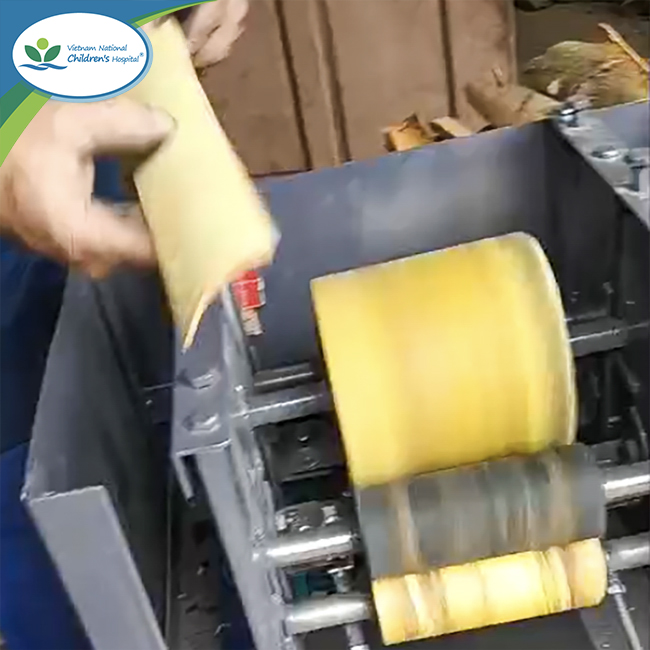
The homemade cinnamon-peeling machine used by the family in production, featuring high-speed rotating rollers, poses a serious injury risk to young children (photo provided by the patient’s family).
Six hours after the accident, the child was transferred to Vietnam National Children’s Hospital after initial first aid at a local medical facility. On admission, doctors at the Department of Emergency and Poison Control assessed severe injuries to the forearm and hand, with multiple structures crushed and a high risk of major functional impairment. After urgent bleeding control, injury assessment, and multidisciplinary consultation, the Department of Orthopedics, in coordination with the anesthesiology team, decided to perform emergency overnight surgery to preserve maximum hand function.
A more-than-3-hour operation to preserve hand function
Dr. Nguyen Vu Hoang, MSc, MD (Senior Specialist), Department of Orthopedics, who directly participated in the surgery, reported that this was an exceptionally complex injury, with multiple flexor tendons, blood vessels, and nerves torn and severely crushed.
“Some tendon segments were extensively damaged, so we had to carefully prioritize reconstruction of the most critical structures to preserve basic hand function. In addition to repairing tendons, vessels, and nerves, the team also reconstructed the tendon-retaining system so that the fingers can later move along the correct axis,” Dr. Hoang explained.
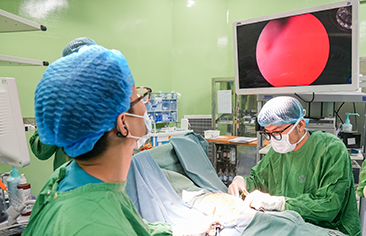
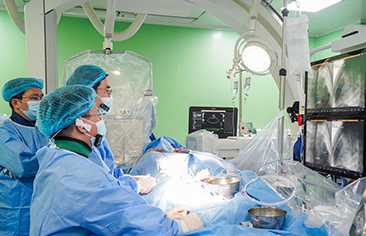
The operation lasted more than three hours. In addition to vascular and tendon repair, the surgeons had to cover soft-tissue defects and restore anatomical alignment.
After surgery, the child’s father shared emotionally that the family had never imagined a production machine could cause such a serious accident.
“Before, we peeled cinnamon by hand. Later, as production increased, we used a machine to improve productivity. Just a moment of inattention led to this accident,” the father said.

The child was treated, cleaned, and re-assessed after surgery.
Following surgery, the child’s hand became warm and pink again, and finger circulation recovered well. Only a few hours after the operation, the child was able to gently move the fingers under medical guidance. After two weeks of treatment, the child recovered well and was discharged. However, full restoration of hand function will require continued follow-up and staged rehabilitation therapy.
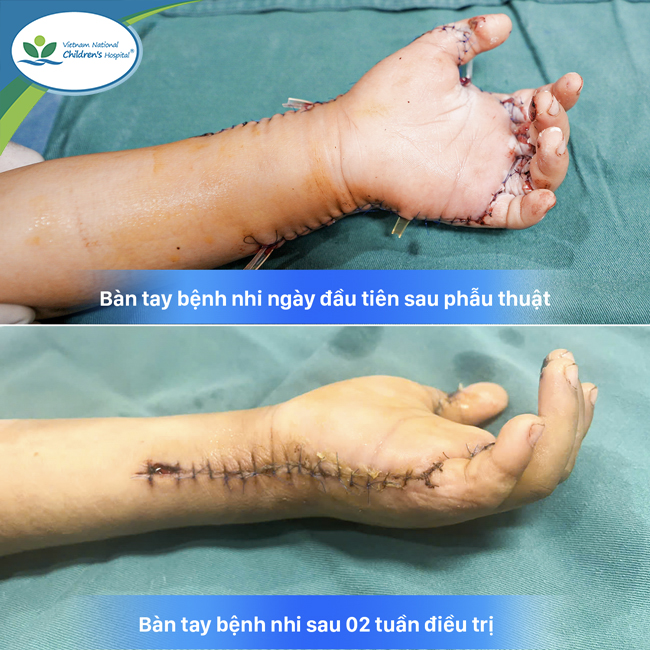
The child’s left hand after surgery and after two weeks of hospital treatment showed positive recovery signs.
Safety recommendations and first aid guidance
From this case, doctors recommend that families and household production sites:
- install barriers to prevent children from entering production areas,
- ensure especially that homemade machines have safety mesh/covers,
- lock power sources, and
- implement emergency shut-off mechanisms to reduce risk.
If an accident occurs—especially involving partial or complete traumatic amputation—immediately cut off the power supply, provide proper first aid to control bleeding, and bring the child to the nearest specialized medical facility as quickly as possible. For an amputated body part, wrap it in clean gauze, place it in a sealed bag, and keep it properly cooled to increase the chance of successful reattachment.
Dr. Nguyen Vu Hoang, MSc, MD (Senior Specialist) – Department of Orthopedics
Digital Information Office – Training and Research Institute for Child Health